
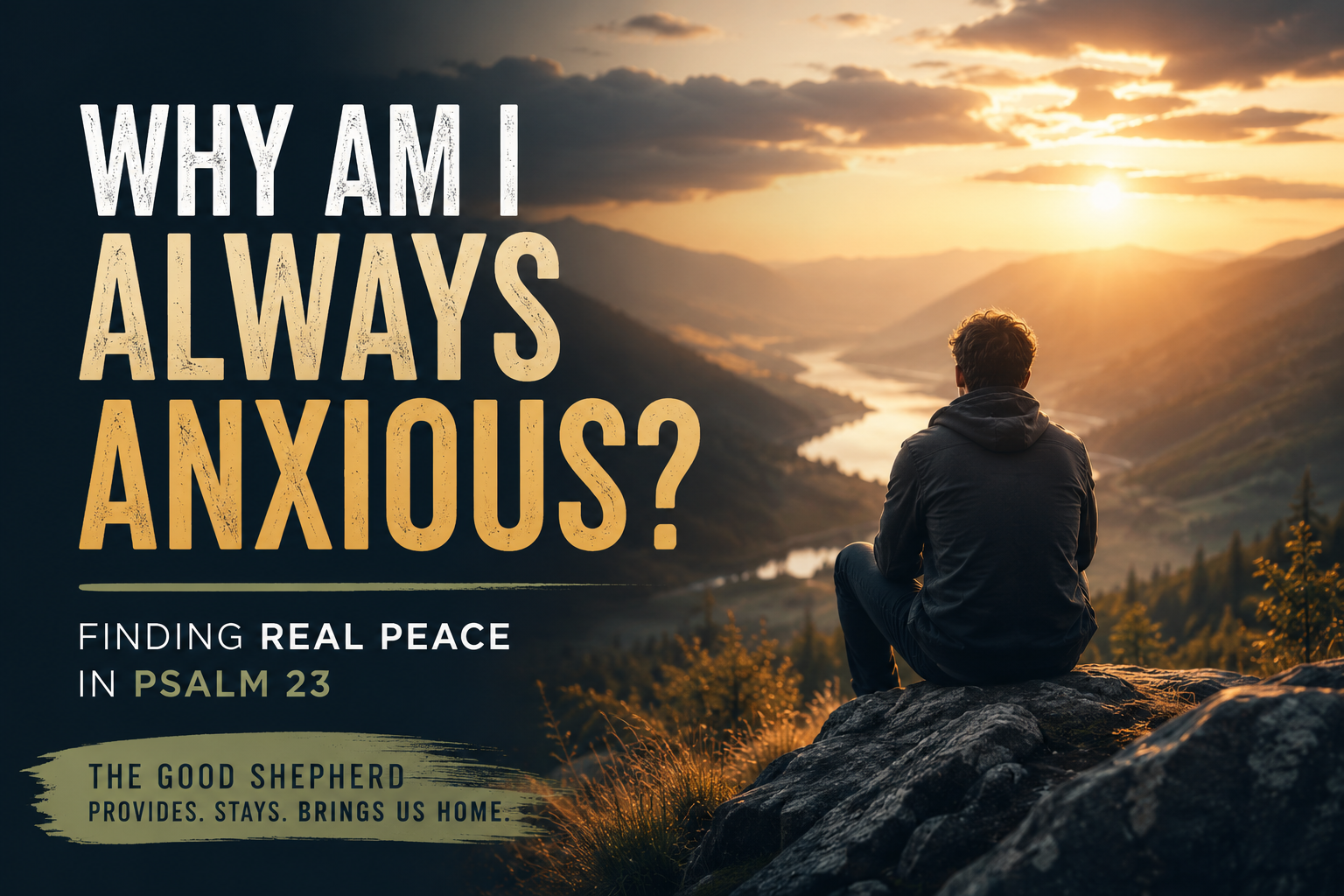
Have you ever asked yourself, Why am I always anxious?
Maybe your mind won’t slow down at night. Maybe you’re carrying the weight of your finances, your marriage, your children, your health, or an uncertain future. Even when life seems to be going well, there’s a nagging feeling that something could go wrong at any moment.
For many of us, anxiety doesn’t look like panic attacks. It looks like constantly checking our phones. Overthinking conversations. Feeling guilty when we slow down. Living with a low-grade sense that we should always be doing more.
We tell ourselves that peace is waiting on the other side of the next accomplishment. If we could just make a little more money, finish the project, get the diagnosis, fix the relationship, or finally get ahead, then we’d be able to rest.
But somehow that day never comes.
The Bible doesn’t ignore those feelings. In fact, one of the most beloved passages in all of Scripture speaks directly to them. Thousands of years ago, King David wrote Psalm 23—not as someone who had an easy life, but as a man who had spent years running from enemies, living in caves, and facing uncertainty.
His answer to anxiety wasn’t positive thinking or pretending life wasn’t hard.
It was a Shepherd.
We Were Never Meant to Carry Life Alone
Psalm 23 begins with a simple declaration:
“The Lord is my shepherd; I shall not want.” (Psalm 23:1)
David doesn’t begin by describing his problems. He begins by describing God.
That alone is worth noticing.
When something goes wrong, most of us immediately focus on the problem. We replay worst-case scenarios in our minds. We ask, How am I going to fix this?
David starts somewhere entirely different.
“The Lord is my Shepherd.”
That image would have been immediately familiar to David because he had actually been a shepherd. He knew sheep well enough to know something that many of us don’t.
Sheep are completely dependent.
They aren’t strong. They aren’t particularly smart. They can’t defend themselves. Left alone, they wander into danger.
Yet they also know something we often forget.
When the shepherd is near, they can rest.
That isn’t because there are no dangers. It’s because someone greater than the danger is watching over them. As several of the major Psalms commentaries observe, Psalm 23 presents the shepherd as the one who continually provides, guides, protects, and remains personally present with his sheep. David’s confidence is rooted not in his circumstances but in the character of the Shepherd.
Maybe that’s why so many of us struggle to find peace.
We’ve been trying to be our own shepherd.
The Rest We Keep Chasing
David continues:
“He makes me lie down in green pastures. He leads me beside still waters. He restores my soul.” (Psalm 23:2–3)
Notice something interesting.
The shepherd doesn’t simply show the sheep where the grass is.
He makes them lie down.
Anyone who has spent time around sheep knows they won’t lie down when they’re anxious. If they’re afraid of predators, they stay alert. If they’re hungry, they keep searching. If there’s conflict in the flock, they remain restless.
Only when the shepherd has dealt with those threats can the sheep finally rest.
That sounds a lot like us.
We’re constantly searching for something that will finally quiet our hearts. We assume peace comes from eliminating every problem. But even when one worry disappears, another usually takes its place.
Psalm 23 offers a completely different picture.
Rest isn’t found in perfect circumstances.
Rest is found in the presence of the Shepherd.
The green pastures and quiet waters aren’t simply beautiful scenery. They picture God’s faithful provision. Throughout Scripture, God is the One who provides for His people and leads them where they need to go. David isn’t saying life will always be easy. He’s saying the Shepherd is always faithful.
God Doesn’t Leave When Life Gets Dark
One of the most surprising moments in Psalm 23 comes in verse 4.
David writes,
“Even though I walk through the valley of the shadow of death, I will fear no evil, for You are with me.”
Something changes here.
In the first three verses David talks about God.
Now he talks to God.
“He leads me…”
“He restores me…”
becomes
“You are with me.”
That’s not an accident.
It’s often in the darkest valleys that our relationship with God becomes the most personal.
Notice something else.
David doesn’t say God keeps him out of every valley.
He says God walks with him through it.
The promise of Psalm 23 isn’t a trouble-free life. It’s the presence of God in the middle of life’s hardest moments.
That changes everything.
The valley doesn’t disappear.
The Shepherd doesn’t leave.
The Peace Anxiety Can’t Produce
So why are we always anxious?
Because anxiety grows wherever we believe everything depends on us.
If I’m responsible for controlling every outcome…
If my security depends entirely on my income…
If my identity depends on my success…
If my future depends on my ability to predict what’s coming…
Then anxiety is almost unavoidable.
Psalm 23 gently invites us to lay down that impossible burden.
The Shepherd sees what we can’t see.
He knows where He’s leading us.
He isn’t surprised by tomorrow.
And He has promised never to abandon His people.
That doesn’t mean Christians never struggle with anxiety. Faithful believers can experience deep fear, worry, and even seasons of overwhelming emotional distress. But Psalm 23 reminds us that our confidence ultimately rests in the character of God, not in our ability to control our circumstances.
The Table in Front of Your Enemies
David finishes the psalm with another powerful image.
God prepares a table for him in the presence of his enemies.
The enemies are still there.
But they no longer control the story.
Instead of fleeing in fear, David is welcomed as an honored guest. His head is anointed with oil. His cup overflows.
The picture is one of God’s abundant care and complete security. The Shepherd who cared for His sheep in the fields now welcomes them home as His honored guests. The movement from shepherd to host highlights the same truth from a different angle: God’s people are safe because they belong to Him.
David ends with one final declaration:
“Surely goodness and mercy shall follow me all the days of my life, and I shall dwell in the house of the Lord forever.”
Most of us spend our lives running after peace.
David says God’s goodness is running after us.
The Good Shepherd
Psalm 23 ultimately points beyond David.
Centuries later, Jesus made an astonishing claim:
“I am the good shepherd.” (John 10:11)
He didn’t merely teach us how to find peace.
He came to become the Shepherd David was writing about.
Jesus laid down His life for His sheep so that anyone who trusts Him can be forgiven, reconciled to God, and brought safely home. The deepest peace isn’t found in getting all the answers you’ve been looking for. It’s found in knowing the Shepherd who gave His life for you.
If you’ve been asking, “Why am I always anxious?” maybe the better question is this:
Who have I been trusting to carry the weight of my life?
Psalm 23 reminds us that real peace doesn’t come from finally getting everything under control.
It comes from surrendering our lives to the One who already is.
Frequently Asked Questions
Does Psalm 23 promise that life will be easy?
No. David speaks about walking through “the valley of the shadow of death.” The promise isn’t the absence of hardship but the presence of God in the midst of it.
What does “The Lord is my Shepherd” mean?
It means God provides, guides, protects, and cares for His people like a faithful shepherd cares for his sheep. Our confidence comes from His character, not our ability.
Can following Jesus help with anxiety?
Following Jesus doesn’t remove every difficult circumstance, nor does it replace appropriate medical or mental health care when it’s needed. But it does give us something anxiety never can: the presence of the Good Shepherd, who walks with His people through every season of life.
Looking for Hope?
If you’re searching for answers, have questions about the Bible, or you’re looking for a Bible-teaching church in Enumclaw, we’d love to welcome you to Calvary Chapel Thunder Mountain. Every Sunday, we open God’s Word verse by verse because we believe lasting hope isn’t found in better advice—it’s found in Jesus Christ.