
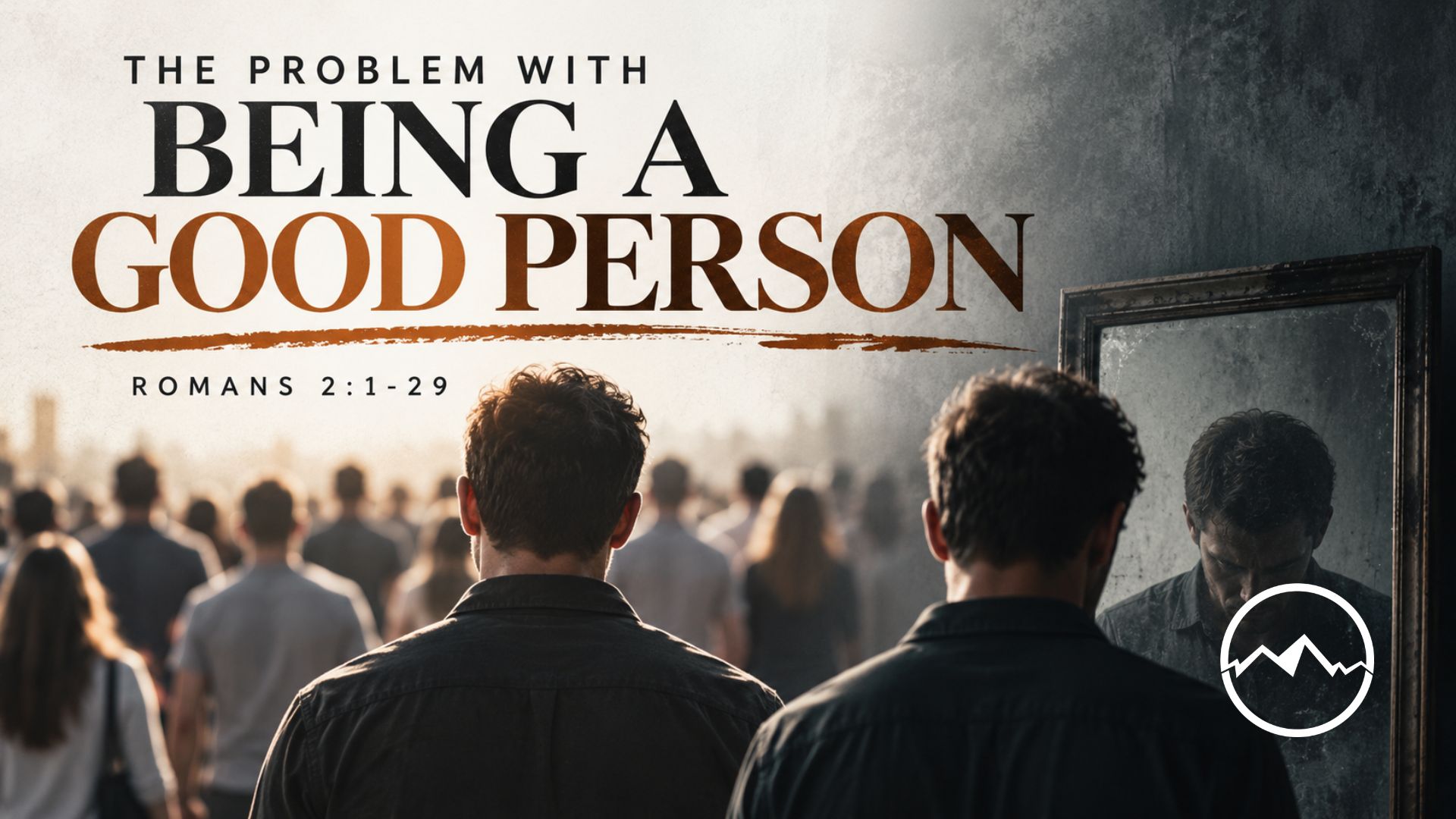
The Problem With Being a Good Person
There’s something in us that loves to compare.
We look at someone else’s life, see the mess they’ve made, and think, Well, at least I’m not doing that. I may have my problems, but I’m a decent person. I work hard. I take care of my family. I try to treat people right. Maybe I go to church. Maybe I know the Bible. I’m certainly not perfect, but compared to those people, I’m doing pretty well.
And that is exactly where Romans 2 gets uncomfortable.
In Romans 1, Paul describes humanity openly rejecting God. People know the truth about God, suppress it, exchange the Creator for created things, and eventually God gives them over to the life they insist on having. It would be easy to read Romans 1 and nod along: Yep. That’s what’s wrong with the world.
Then Paul turns to the person doing the nodding.
“Therefore you have no excuse, O man, every one of you who judges.” — Romans 2:1
Romans 2 confronts one of the most common ways we convince ourselves that we’re okay with God: we compare ourselves to people who seem worse than us. But God doesn’t compare us to other people. He judges us according to truth.
And that creates a much bigger problem than most of us realize.
“But I’m Better Than Them”
Paul begins with the person who can clearly see the sin in someone else’s life. The problem isn’t that his judgment is necessarily wrong. Some things really are sinful. Romans 1 just spent an entire chapter saying so. The problem is that he sees sin clearly in others while excusing it in himself.
That is a remarkably easy trap to fall into.
We tend to grade ourselves on a curve. We find someone whose marriage is worse than ours, whose temper is worse than ours, whose drinking is worse than ours, whose sexual sin is more obvious than ours, or whose life is simply messier than ours. As long as we can find somebody doing worse, we can reassure ourselves that we’re doing pretty well.
But God doesn’t grade on a curve.
Paul says that God’s judgment “rightly falls on those who practice such things.” The standard isn’t whether I’m better than my neighbor. The standard is truth. And once that becomes the standard, comparison stops being much help.
In fact, Paul asks a penetrating question in verse 4: do we presume on “the riches of his kindness and forbearance and patience”?
Sometimes we mistake God’s patience for God’s approval. Nothing terrible has happened. Life is going reasonably well. God hasn’t struck us down. So we assume everything between us and God must be fine.
Paul says we have it backward. God’s kindness is meant to lead us to repentance. His patience isn’t evidence that our sin doesn’t matter. It is an opportunity to turn around before judgment comes.
That means the right response to seeing someone else’s sin isn’t, Thank God I’m better than that. It ought to make me ask, Where am I doing the same thing? Where am I excusing what God has called sin?
“But I Know What’s Right”
Paul then removes another hiding place: knowledge.
For his original audience, the issue was the Law. The Jewish person had something the Gentile did not have: God had actually revealed His Law to Israel. They knew what God required.
Surely that counted for something.
It did—but knowing God’s Word and obeying God’s Word are not the same thing.
Paul writes, “For it is not the hearers of the law who are righteous before God, but the doers of the law who will be justified.” His point is not that we earn salvation by doing enough good works. His point is that merely possessing the truth does not make us righteous.
That lands pretty close to home for church people.
You can grow up in church. You can know the books of the Bible. You can understand theology. You can listen to sermons every week and know exactly what the pastor is going to say before he says it. You can even be able to explain to somebody else what God says about marriage, sexuality, money, forgiveness, anger, pride, or integrity.
None of that means you are actually submitting your life to God.
There is a dangerous kind of Christianity that knows all the right answers but has learned how to keep those answers at a safe distance from the heart. We can become very good at recognizing truth without allowing that truth to confront us.
Romans 2 won’t let us hide there either.
“But I’m Religious”
By the second half of the chapter, Paul gets even more specific. He turns directly to the person who says, “I am a Jew,” who possesses the Law, who knows God’s will, and who sees himself as a guide to others.
In other words, this person has a religious résumé.
For the Jewish person, one of the great outward signs of covenant identity was circumcision. It marked him as belonging to the people of God. But Paul says something shocking: if the outward sign is not accompanied by the reality it represents, the sign itself cannot save you.
That principle has an obvious application for Christians today, even though Paul is specifically talking about Jewish circumcision in the passage. We have our own religious credentials.
I grew up in church. I was baptized. My parents were Christians. I know the Bible. I serve. I give. I’m a member. I prayed a prayer when I was a kid.
Those things may be good. Some of them are things Christians absolutely should do. But none of them can make a sinful person righteous before God.
Paul brings the entire argument down to the heart: “No one is a Jew who is merely one outwardly, nor is circumcision outward and physical.” Instead, he speaks of “circumcision” as “a matter of the heart, by the Spirit, not by the letter.”
Paul has systematically taken away every place we like to hide. I’m better than them. Comparison won’t save you. But I know what’s right. Knowledge won’t save you. But I’m religious. Religious identity won’t save you either.
And that brings us to the real problem with being a good person.
The Problem With Being a Good Person
The problem isn’t that being good is bad. The problem is believing that our goodness makes us right with God.
If I think I’m basically a good person, then I don’t think I need to be rescued. Maybe I need a little help. Maybe I need some improvement. Maybe I need God to smooth out a few rough edges. But I certainly don’t need saving.
Romans is dismantling that idea.
Romans 1 takes away the excuse of the openly rebellious person. Romans 2 takes away the excuse of the moral and religious person. And Paul is driving both groups toward the conclusion he will make explicit in Romans 3: we all need Jesus.
That’s why Christianity is not fundamentally about bad people becoming good people. It is about guilty people being made right with God through Jesus Christ.
Jesus did what none of us has done. He lived without sin. He perfectly obeyed the Father. Then He went to the cross and took the judgment sinners deserved upon Himself. He died, was buried, and rose again.
Our hope, then, isn’t that when we stand before God we can point to somebody worse than us. It isn’t that we knew more Bible verses than somebody else. It isn’t that we went to church, got baptized, served in ministry, or built an impressive religious résumé.
Our hope is Christ.
So maybe the question Romans 2 leaves us with isn’t, “Am I a good person?”
A better question is: “Am I trusting in my goodness, or am I trusting in Jesus?”
Because when we stop comparing ourselves to everyone else and allow God to judge us according to truth, “pretty good” isn’t enough. What we need is mercy. And that is exactly what God offers us in Jesus Christ.
Join Us This Sunday
If you’re looking for a church, we’d love to have you join us this Sunday at Calvary Chapel Thunder Mountain. Come as you are, bring your questions, and grow with us as we learn what it means to follow Jesus.